Museo del Camposanto Teutonico / Museum of the Teutonic Cemetery

Name
Location
Type of location
Cronology
Authors
Description
The Museum of the Camposanto Teutonico was founded at the end of the nineteenth century by Monsignor Anton de Waal, the first director of the Römisches Institut der Görres-Gesellschaft and a Christian archaeology scholar involved in important archaeological excavations in catacombs and churches in Rome. The museum was established to store his founds and with didactic intentions for the study of Christian antiquities.
The museum occupied three different locations within the Cemetery. The first museum was established in the former Hospice. There are no photographs relating to this phase, and we rely on de Waal's letters. There was only one large exhibition room all dedicated to Christian archaeology, in which the few pagan fragments in the collection were used to Christianity. This special room was prepared especially for Christian antiquities: the ceiling and walls were decorated with paintings of the catacombs and inscriptions (some of them copies).
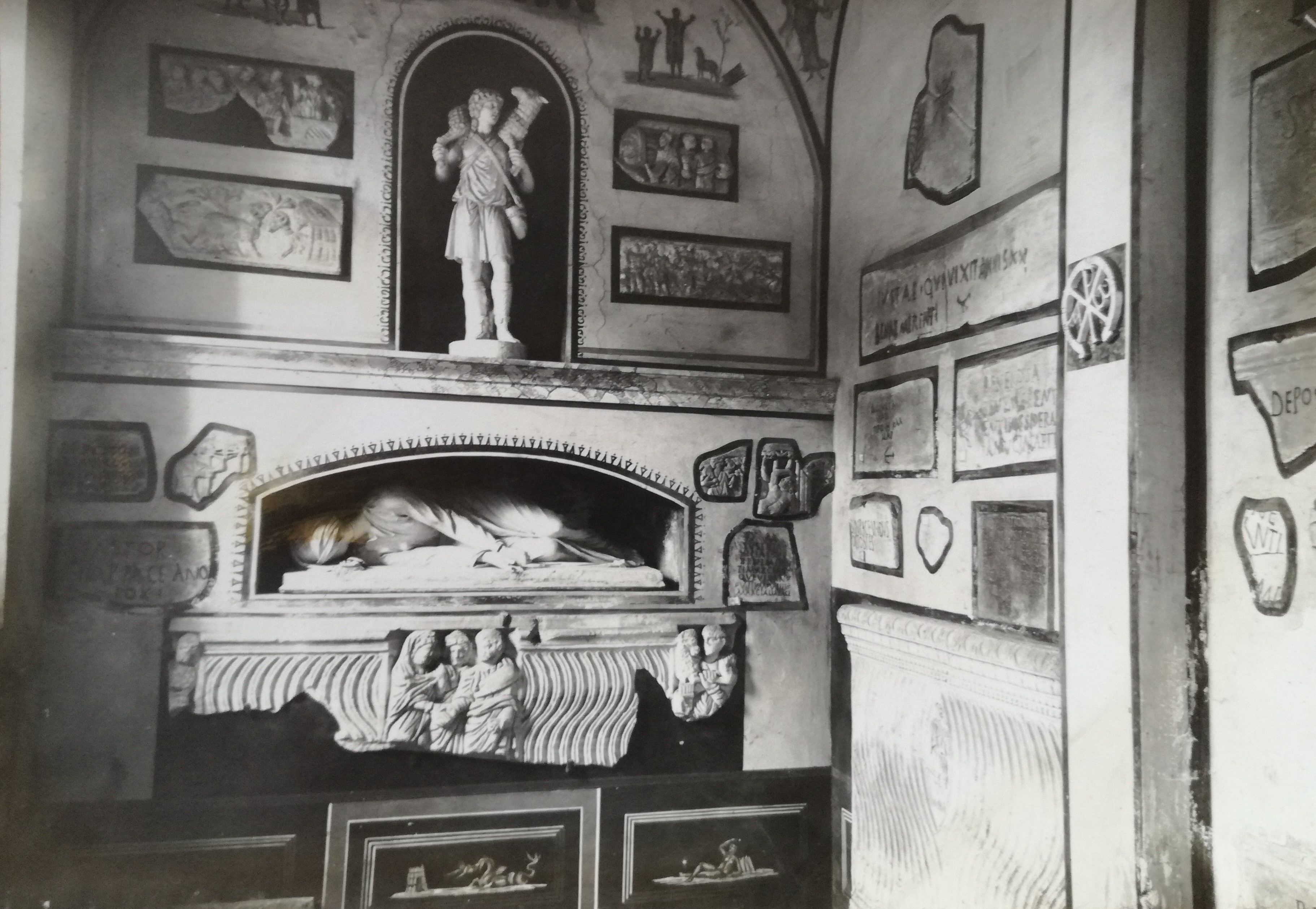
Shortly after the opening, de Waal planned to move the museum to the Damenstift. In 1885, he had the ground floor and a cellar rebuilt to open the new museum hall. In the basement rooms, a room in imitation of a double burial chamber of a catacomb was installed: it was a vaulted room decorated on the ceiling and walls with copies of catacomb paintings, inscriptions and sculptures embedded in the walls, lamps and terracotta were arranged in showcases. A small hypogeum then offered an imitation of a 'cubiculum duplex cum arcisoliis et luminare'. Some original photographs belong to this phase. The two basement rooms, all decorated with bands of red and green lines typical of the catacombs, were vaulted and connected by a short corridor, painted with motifs from the catacomb of Callisto. At the top and bottom of the walls and in the vaults, motifs and scenes from the catacombs of Callisto were copied. On the walls of the largest room were sarcophagi and numerous funerary inscriptions from the catacombs. Above one of the sarcophagi was an arcosolium niche with a copy of the statue of St. Cecilia by Stefano Maderno and, above it, another niche with a copy of the statue of the Good Shepherd from the Lateran Museum.
The setting was not a perfect copy of a specific catacomb, but rather came very close to the 'period rooms' of German museums. It served to recreate the impression of a generic catacomb, according to an aesthetic, didactic and catechetical intention, but not a philological one. It had to only remind visitors of an architectural setting very similar to the original catacomb one.
Present State
Sources
Archive of the Camposanto Teutonico, Jahresbericht der Görres-Gesellschaft; Fotos; Piante.
Archive of the Camposanto Teutonico, Chronik Anton de Waal
Archive of the Camposanto Teutonico, Fotos; Piante.
Archive of the Camposanto Teutonico, Piante.
References
Cecalupo, C. (2022). Catacumbas en museos: archivos documentales y fotográficos para la historia de la museografía’, Anales de Historia del Arte, 32, 235-253, doi: 10.5209/anha.83070 https://revistas.ucm.es/index.php/ANHA/article/view/83070
Heid, S. (2016). Wohnen wie in Katakomben. Kleine Museumsgeschichte des Campo Santo
Teutonico. Regensburg: Schnell und Steiner.