Museu Biblíc Tarraconense / Biblical Museum of Tarragona

Name
Location
Type of location
Cronology
Authors
Description
The new Biblical Museum of Tarragona (funded in 1930 to teach biblical history to seminarists) reopened in 20006 after a long restoration campaign. The 'Hall of the Expansion of Christianity' is a longitudinal space that reconstruct a kind of early Christian basilica, with four pillars and an apsidal basin painted with stars, a gem-studded cross, the four Evangelists, and palms on a blue background. The appearance explicitly recalls the typical mosaic decoration of the apses of Roman churches. In the floor in the centre of the room has been inserted the copy of the mosaic that closed the tomb of Optimus in the necropolis of Tarragona, recalling the presence in early Christian basilicas of floor tombs of various kinds. A small mosaic with a Eucharistic theme of fish and loaves, a copy of a detail from the floor of the Church of Multiplication in Tabgha/Cafarnao, has been placed in the floor as well.
On the back of the apsidal area there are two small rooms. The room on the right hosts a reconstruction of a small baptistery, mosaic-covered on the inside after North African examples. On the wall, a fresco scene of Adam and Eve recalls a catacomb painting.
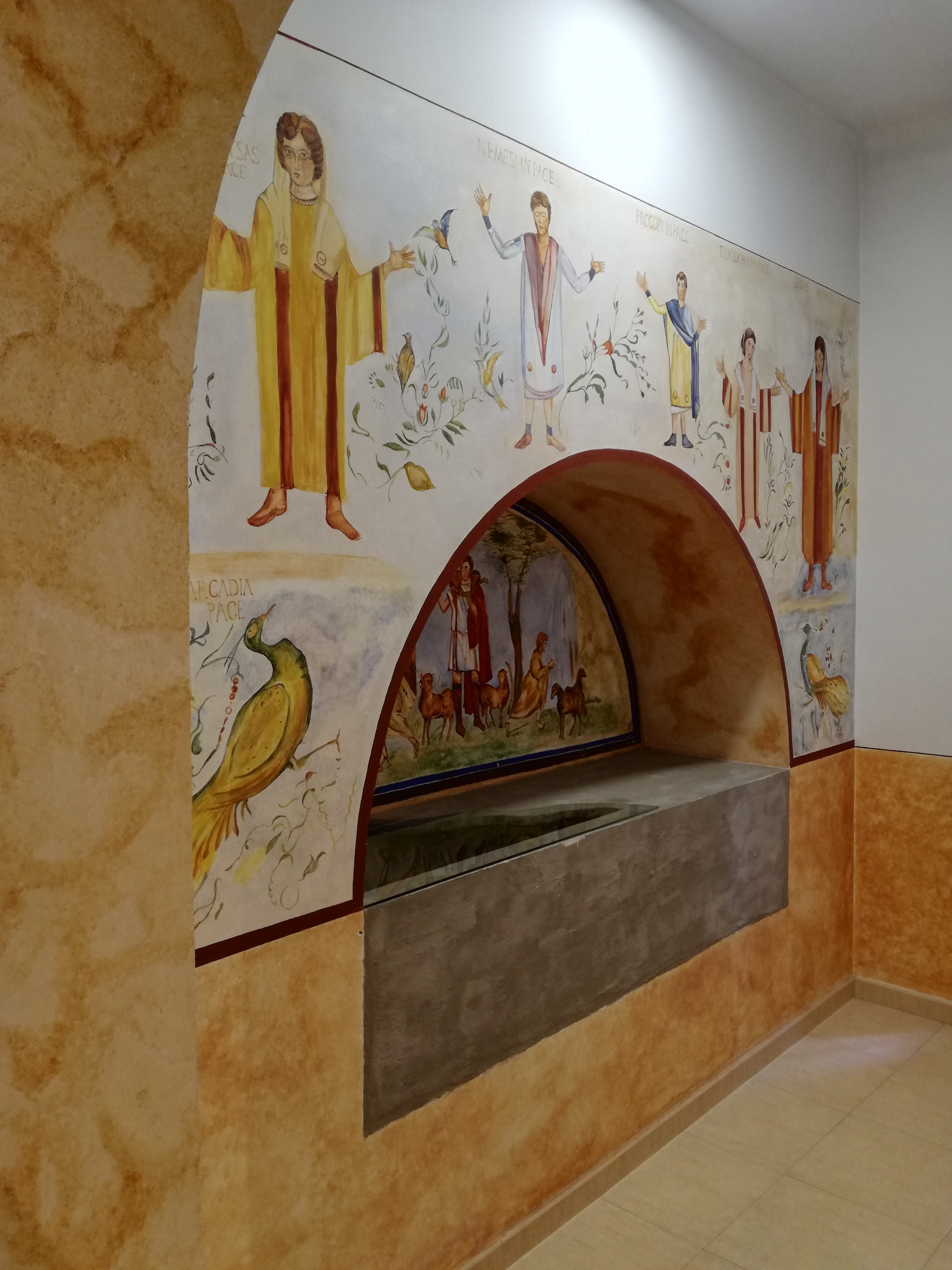
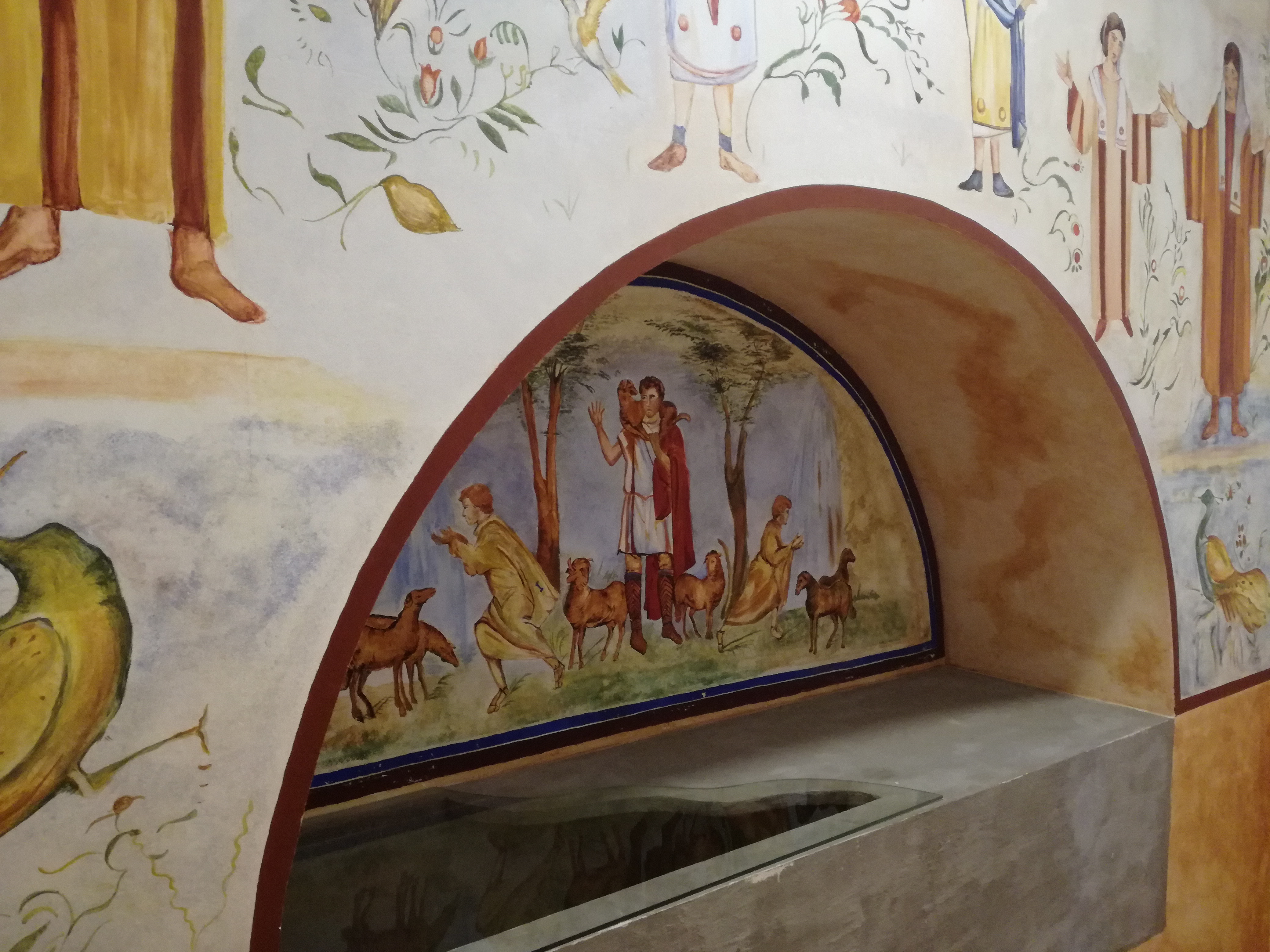
The entire long wall of the room on the left is occupied by the reproduction of an arcosolium of a Christian catacomb of Rome. The lower part is the reconstruction of the tomb with the body of the deceased, closed by a glass panel. The decoration on the higher section of the wall generally reproduces the upper part of the painted wall of the so-called cubiculum of the Five Saints from the catacombs of San Callisto in Rome. On the sides of the arcosolium, the two peacocks with painted inscriptions. On the back wall, there is a painting of the Good Shepherd from the same catacomb.
Present State
References
Muñoz Melgar, A., Museum Biblicum Tarraconense, Escua, Barcelona (2011).