Church State Pavilion at the Universal Exhibition in Paris in 1867



Name
Location
Type of location
Cronology
Authors
Description
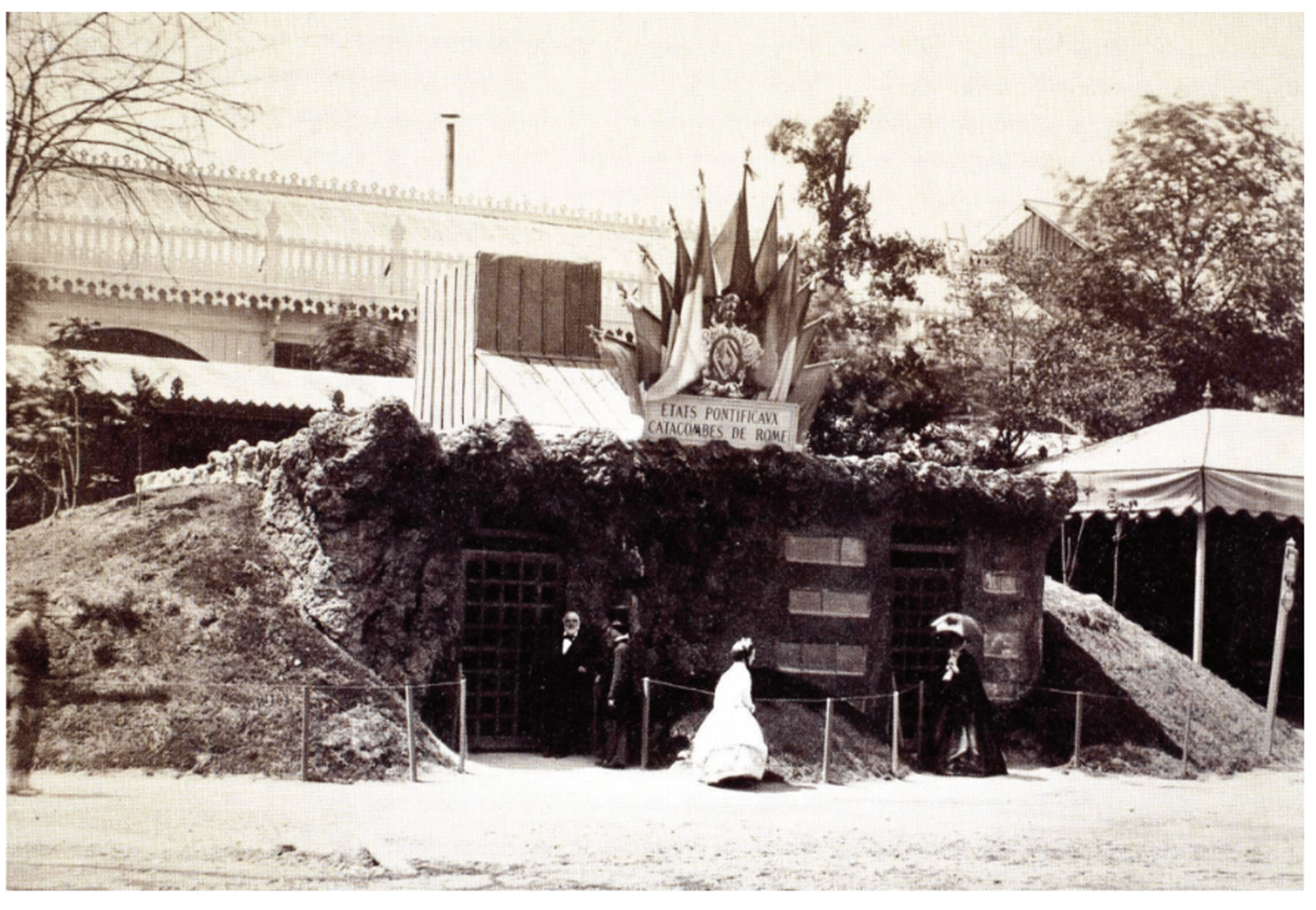
Pope Pius IX chose to participate in the Universal Exhibition in Paris in 1867 in a grandiose manner, celebrating the architectural works and new institutions for Christian archaeology that he had promoted. The main attraction of the Papal State at the Universal Exhibition in Paris was located among the ephemeral structures in the park of the Champ de Mars. It was a small facsimile catacomb that ideally represented a prototype of a Christian cemetery with all its distinctive features. It was indeed a model of a catacomb in real size and volume, re-proposing open and closed galleries, a cubicle and the main Christian burial methods, and offering the visitor the experience of an inviolate Christian hypogeum. The choice was to reproduce pieces -as well as their arrangement- that could explain clearly the oldest Roman catacombs and their main features.
It was a structure of wooden planks and cork, with an internal skeleton, covered by clods of earth and vegetation to create a mound It gave the impression of entering an underground environment like in the original ones. The front of the facsimile catacomb occupied almost nine metres and was decorated with casts of Christian inscriptions embedded between the entrance and exit doors. Visitors entered on the left and exited on the right.
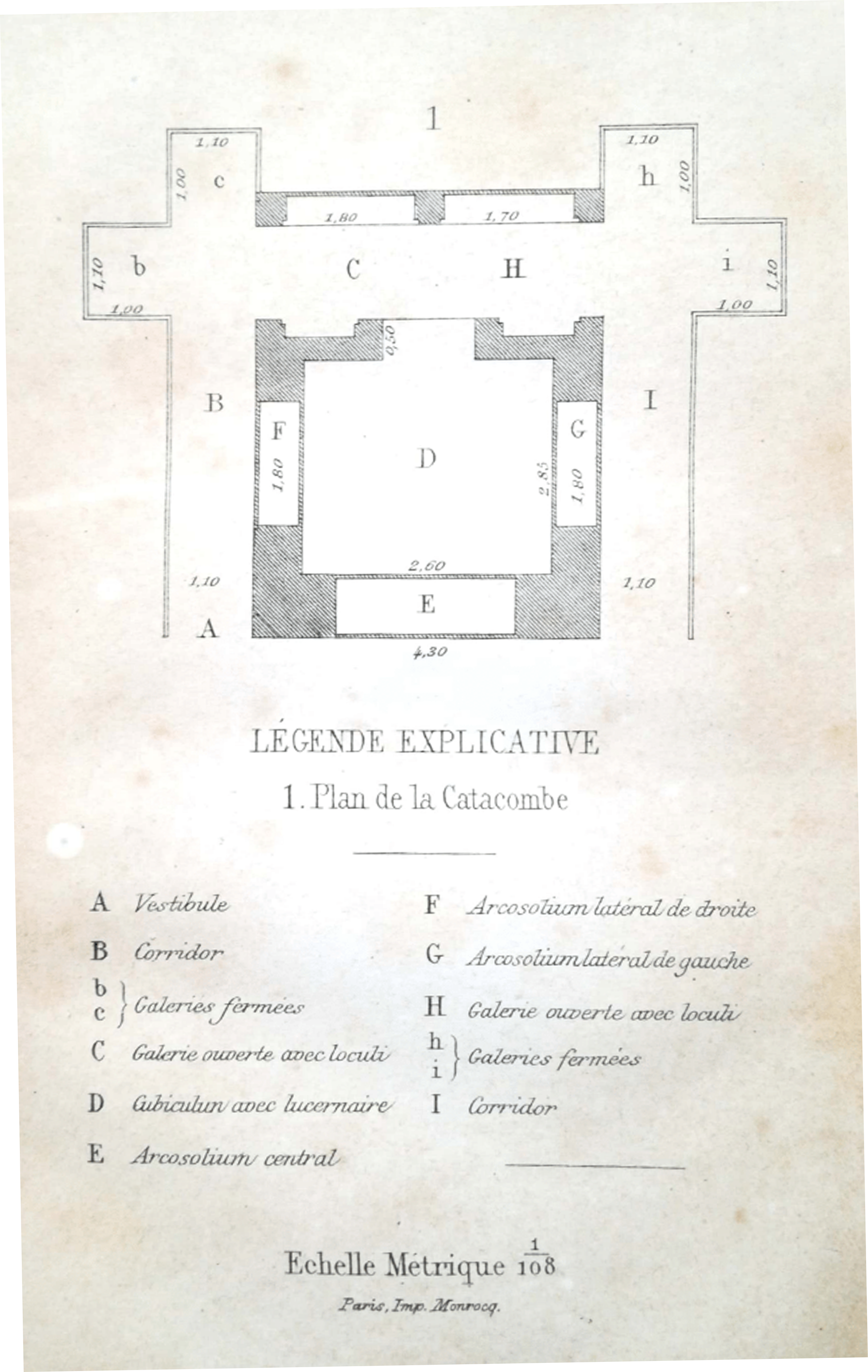
From the entrance vestibule A one proceeded to gallery B, which showed all the features of the sepulchral tunnels, and then into gallery C, which had loculi on both sides, with copies of catacomb inscriptions and paintings such as the so-called Virgin of Priscilla. In the centre of the monument was chamber D, which aimed to represent a syntesis of all the cubiculae of the Roman catacombs in small scale, with reproductions of frescoes (in particular from St. Callistus) and a copy of the large central skylight from St. Callistus in the centre.
Present State
Sources
Biblioteca Apostolica Vaticana, Vat. lat. 14246
Archivio di Stato di Roma, Ministero del commercio, belle arti, industria, agricoltura e Lavori Pubblici, b. 393
References
CHIARA CECALUPO, ´Giovanni Battista e Michele Stefano de Rossi all’Esposizione Universale di Parigi (1867)´, Rivista Di Archeologia Cristiana, 97, 2021, 319-347
G. CAPITELLI, L’archeologia cristiana al servizio di Pio IX: la ‘catacomba fac-simile’ di G. B. de Rossi all’Esposizione Universale di Parigi del 1867, in A. COSCARELLA, P. DE SANTIS (ed.), Martiri, Santi, Patroni: per una archeologia della devozione. Atti del X Congresso Nazionale di Archeologia Cristiana (Reggio Calabria, 15-18 settembre 2010), Reggio Calabria 2012, pp. 555-566.
G.B. DE ROSSI, Aperçu général sur les catacombes de Rome et description du modèle d'une catacombe exposé à Paris en 1867, Parigi 1867.
Elenco generale ragionato di tutti gli oggetti spediti dal Governo Pontificio alla Esposizione Universale di Parigi nell’anno 1867 per mezzo del Ministero del Commercio, delle Arti, Industria, Agricoltura e Lavori Pubblici, Roma 1867.
Grand album de l'Exposition Universelle 1867: 150 dessins par les premiers artistes de la France et de l'Étranger, Paris 1868.
L’Esposizione Universale del 1867 Illustrata. Pubblicazione internazionale autorizzata dalla commissione imperiale, Milano-Firenze-Venezia 1867.