Crypt of the Church of the XII Apostles

Name
Location
Type of location
Cronology
Authors
Description
The large crypt below the presbytery and altar of the Church of the XII Apostles in Rome was purpose-built as a catacomb in the second half of the nineteenth century.
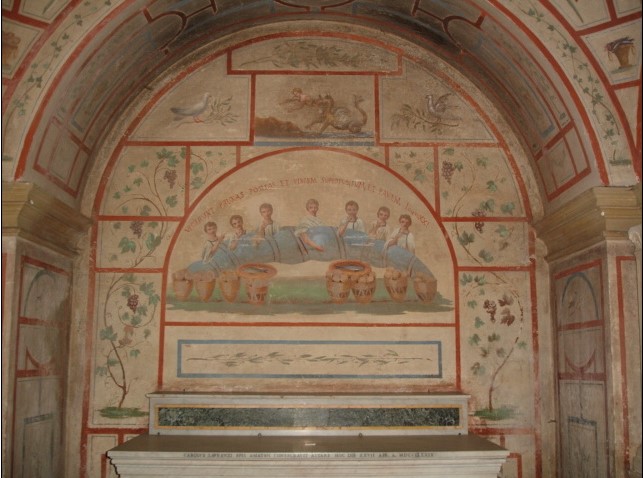
Between 1870 and 1884, the crypt of the church was excavated and renovated to improve the arrangement of the relics of the Apostles Philip and James resting there. The idea was to create, in the centre of Rome, and around the relics of the two Apostles, the feeling of being in a real catacomb thanks to faithful copies of the best-known paintings of underground Christian cemeteries.
The pictorial decoration was spread with fresh lime on the tuff walls to imitate the frescoes as closely as possible. It was executed in the years 1877-1882 (with final touch-ups in 1884) by painters Prospero Piatti, Guglielmo Ewing and especially Giuseppe Mari.
The crypt was structured in small niches reminiscent of the arcosoli of the catacombs. In the arcosoli and on the walls, marble tombs of varying chronology already present in the crypt were placed.
The result was so impressive that the Commission of Sacred Archaeology on the 31st of January 1883 severely condemned the construction of burial niches, arcosoli and facsimile burial inscriptions. Secretary de Rossi identified these errors of interpretation and decreed the immediate destruction of the burial niches and false epigraphs, which fortunately was never carried out. Eventually, the Commission had to ask the church's parish priest to make it clear to visitors with special signs that these were copies in painting, to avoid confusing them about the originality of the paintings or creating a kind of false worship.
The crypt was therefore decorated with a pure imitation of the ancient iconography of the Christian catacombs, albeit with different adaptations and personal interpretations. The decorations are either famous scenes and subjects from early Christian iconography (Good Shepherd, the Praying People, the Multiplication of the Loaves and the Banquet Scene, the Resurrection of Lazarus, the Miracle of the Spring, Daniel among the Lions, Jonah, Adoration of the Magi) or symbolic and ornamental depictions (fish, doves, sheep, peacocks, monograms). Most of these subjects were inspired by the original paintings in the catacombs of Domitilla, Callisto and Priscilla.
Present State
References
Mazzucco, I. (1989). “L'iconografia di imitazione nella cripta romana dei Santi XII Apostoli”, in Strenna dei Romanisti, 1989, pp. 341-359.